
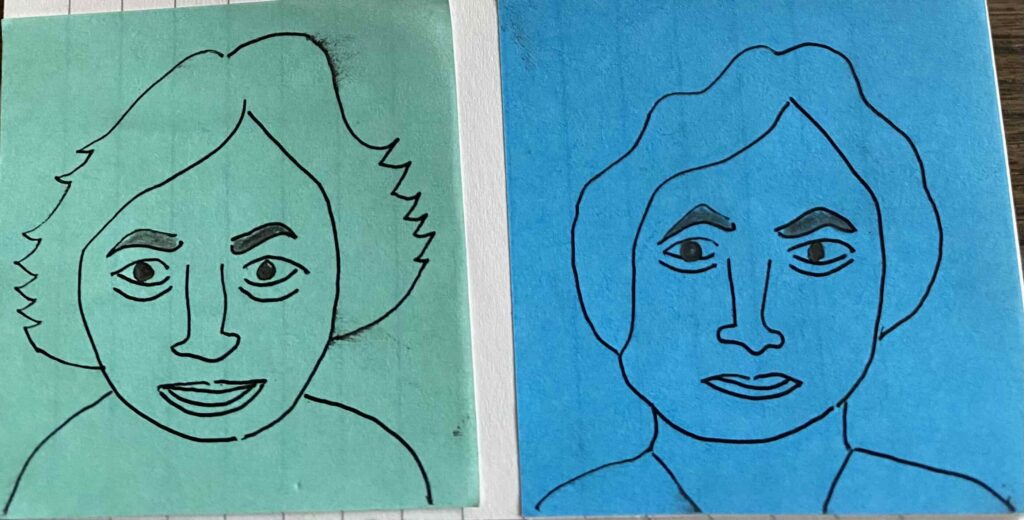
This art is before coloring.
Mahdokht Parhami
used to work as a teacher and assistant principal, to Mr. Ehteshami. He liked her and invited her to attend a cinema screening at night. Mahdokht was caught unawares, even though she saw her teacher colleagues smirking when the principal spoke to her. She resigned from her job without serving any notice.
Mahdokht didn’t understand herself. She thought hse was taking the moral high ground, but actually, she hurt herself. One year after she quit her job, she heard news that Mr Ehteshami married Miss Atai, another teacher in the school.
She “felt such a tightness in her chest as if her heart was about to burst out.”
(Parsipur, p. 5)
Mahdokht spent her time knitting for Houshang Khan’s children, for 11 years. Imagine how she could have allowed herself to be wooed by Mr Ehteshami and maybe married him and have her own children. A woman without a man, without an outside job and without direction, has spent the prime of her youth knitting for a man’s children. This short story illustrates the title of the book, Women Without Men.
Towards the end of the book, Mahdokht was portrayed as a tree. This is an allegory. She was fertile and scattered her seeds (goodness) to the world.
“The tree was now a mountain of seeds. …… The seeds traveled with the water to all corners of the world.”
(Parsipur, p. 112)
Perhaps Mahdokht did some things to spread her good deeds, to all over the world.
The second story is named after a woman called Fa’iza. She has been fighting with her sister-in-law and gossips to her female friend, Munis, a married woman, about how she has won another round of fight. Fa’iza is a woman without a man and she fights with her sister-in-law. According to Fa’iza, it is because Parveen criticizes her.
About the author Shahrnush Parsipur
She was born in Iran in 1946. She started getting noticed when she worked as a producer and writer for Iranian National TV and Radio. She was a feminist who pushed the boundaries of her culture and religion in her works. Unsurprisingly, she was jailed for five years. After her release, she had this book, Women Without Men published. It was banned in Iran, but has been selling via the underground network. She was again jailed. She decided to exile herself to California.
I have not visited Iran. I would say that in any country, culture and religion, there are boundaries. Even social boundaries would expect limits on publicly acceptable behaviors.
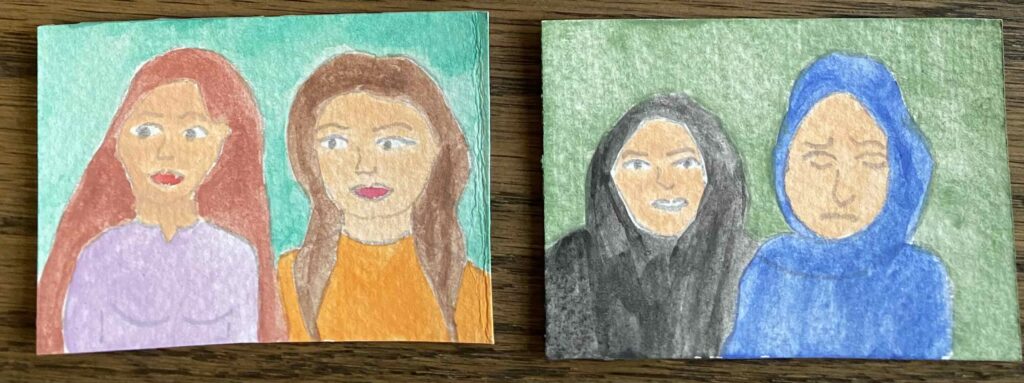
The second story in the book is titled “Fa’iza”
is 28 years old and she likes Amir Khan. This bachelor chose to remain single to take care of his sister Munis. Fa’iza talks to Munis, to try to win favor in her eyes. She thought Mnis might put in a good word for her, to her brother Amir Khan.
Both Fa’iza and Munis are women without men. One afternoon, they discuss virginity and the hymen.
Munis had always desired to climb trees but restrained herself for fear of tearing her hymen. After her talk with Fa’iza, Munis became angry for her misconception. She had so badly wanted to climb trees but was restrained from her desire. She thought of killing herself by falling down from her window. She does that. She faints and when she awakes, she wanders the street for a month.
Amir Khan searches for his lost sister in vain. When she finally returns home, he is outraged with her and flogs her with his belt. He then stabs her. Munis loses consciousness.
It is ironic that Munis, a woman without a man husband, is supposed to be protected by her brother, and yet he stabs her. She faints.
When the siblings’ parents walked in and saw Munis’ lifeless body, they faint.
When Fa’iza comes, she helps Amir Khan bury Munis in a shallow grave.
Amir Khan, under the impression that Munis is dead, tells his mother that he wishes to get married. He chooses an 18 year old woman under the false impression that she is a virgin, and righteous.
Fa’iza heard Munis calling to her from her grave and she digs out Munis. The latter confronts Amir Khan and his unchaste bride. Munis threatens revenge on her brother if he does not treat his new wife well.
It is ironic that Amir Khan, who has been watching his spinster sister his whole adult life, has been cheated into marrying a fake virgin.
Munis, a woman with no man, has her revenge, by leaving her neonatal family, to go and live with another woman, Fa’iza, who has no man.
There are stories of women without men. These women travel to Karadj where they meet the rich women who has a house to allow them to stay there.
At the end of the book, the women have different endings. Mahdokht and Munis remained single.
Fa’iza, Mrs Farrokhlaqa Sadroddin Golchehreh and Zarrinkolah became attached to men.
The end.
Leave a Reply