
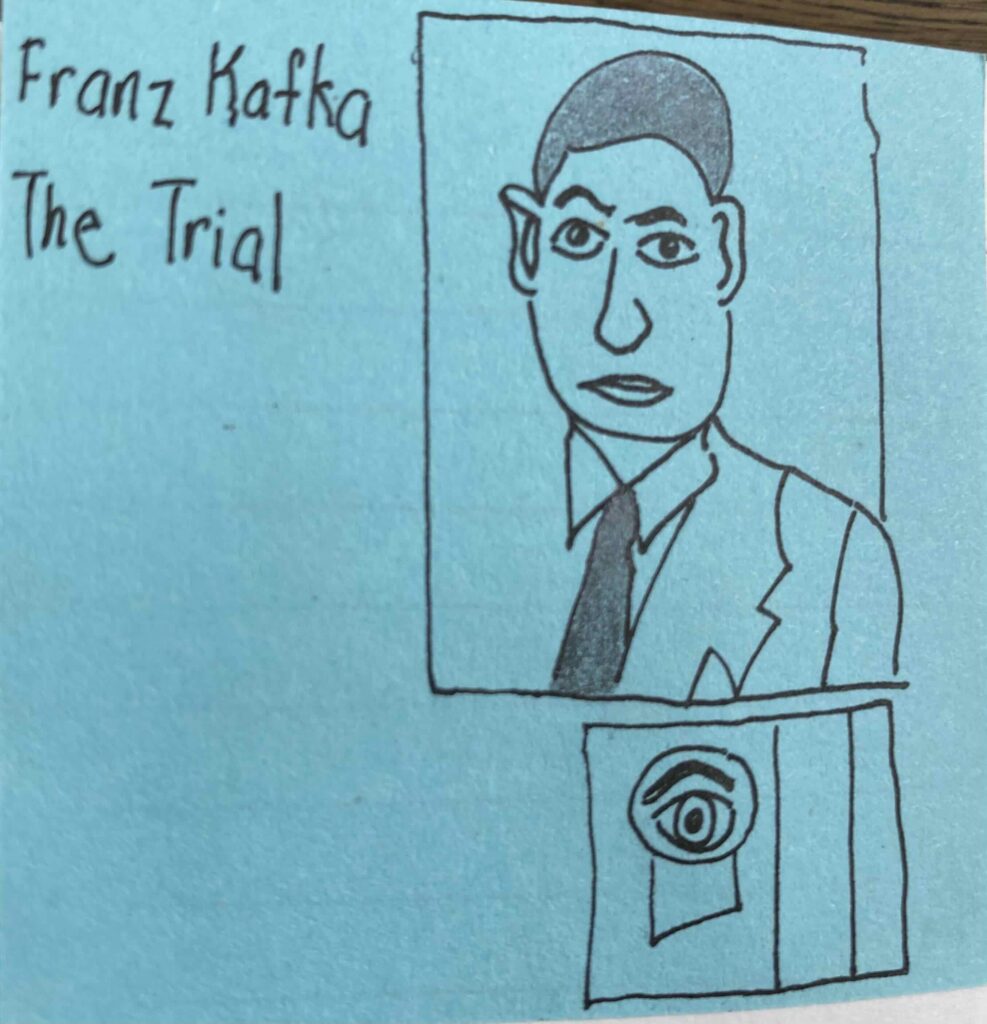
What is the secret of Franz Kafka’s The Trial? It was inspired by his relationships with women. Where did he get the idea for his plot?
Kafka’s narrative for Josek K reveals this character as being easily attracted to women. He was aroused by his boarding house mate Fraulein Burstner, and the private court room usher’s wife, an un-named woman.
Josef K too advantage of the Fraulein Burstner’s late night fatigue, to launch a pile of kisses on her face and neck.
Kafka, in real life, was also attracted to young women. When his fiancee Felice sent her friend Grete Bloch to see him, to mediate on their engagement, Kafka “was instantly attracted to the newcomer”. This was written by Kafka’s translator, Idris Parry. (Kafka, p. xiii).
Kafka seems to have got his idea for the plot of The Trial, from his personal experiences with his courtship, engagement and breakup with his girlfriend Felice. (Kafka, p. xiii). They met twice. He then told Felice he delayed his commitment to get consolation from his pending engagement and marriage.
Felice asked her friend, Grete Bloch to be their in-between, to discuss, negotiate and discover what were the problems hindering the engagement and marriage. Kafka confided in Grete his insecurities and she was persuaded to believe that he wasn’t ready for marriage.
Kafka was attracted to Grete because she represented no threat to him, whereas Felice meant marriage and interference in his writing. He thought his writing was his channel to stay alive. (Kafka, p. xiv)
Kafka sat through his engagement ceremony feeling captured and tied up in a cage, imprisoned, to stop him from writing.
Grete Bloch changed her mind about supporting the idea of marriage for kafka and Felice. She persuaded Felice that Kafka was unprepared for marriage and would make a difficult husband. (Kafka, p. xiv)
Kafka had written to Grete to tell her he was attracted to her and was likely to maintain his relationship with her even with any ties to Felice.
Although Kafka told Grete he doubted his engagement to Felice,b yet he did not admit this to Felice, Grete and Erna (Felice’s sister). He kept quiet.
The Trial represented Kafka’s experience with his engagement and then dis-engagement. He was wrong to get engaged. He felt like he was put through a trial although he didn’t say anything. He didn’t speak up to break off his engagement.
Kafka reinvented real life women like Felice, and Grete Bloch, to transform them into Fraulein Burstner and the court usher’s wife. The fictional women could not protest, or call on their moral and legal rights. They allowed themselves to be handled by men.
Related posts:
- https://booksreviewsandmore.com/what-did-josef-eat-for-breakfast-on-the-morning-two-policemen-arrested-him/
- https://booksreviewsandmore.com/fraulein-burstner-the-supervisors-table-in-kafkas-the-trial/
- https://booksreviewsandmore.com/when-did-the-court-ushers-wife-try-to-seduce-herr-josef-k/
- https://booksreviewsandmore.com/why-did-fraulein-burstner-the-court-ushers-wife-accept-the-mens-caresses/
- https://booksreviewsandmore.com/josefs-magistrate-reads-the-torments-grete-had-to-suffer-from-her-husband-hans/
- https://booksreviewsandmore.com/what-happened-between-josef-k-and-leni/
- https://booksreviewsandmore.com/who-are-the-women-who-josef-k-likes/
- https://booksreviewsandmore.com/what-are-the-absurdities-in-kafkas-the-trial/
Leave a Reply